

Written by Kaija Jumppanen Andersen[1], Lydia Cumiskey[2], Holly Faulkner[3]
[1] Technical University of Denmark
[2] University College Cork
[3] University College Cork
Introduction
A core part of building societal resilience to disasters is through planning and decision-making ahead of events. However, making decisions around implementing measures for both disaster risk management (DRM) and climate change adaptation (CCA) is complex and requires balancing different interests and priorities across different stakeholders including citizens. There are a variety of different decision-support tools that can be used to assist decision-makers when considering these critical choices, one of which is Multi-Criteria Decision-Making (MCDM). The MDCM tool, being developed by ETH Zurich within CLIMADA can help Real World Lab stakeholders explore the effects of different criteria and weights, when considering potential CCA/DRM measures. These criteria encompass cost, public acceptance, environmental, and social benefit.
This is a shift away from purely cost-benefit analysis towards value-led decisions, recognising the complexity of addressing DRM and CCA measures. In the context of DIRECTED, a Real-World Lab (RWL) is a place-based testing environment where disaster-risk innovations are co-developed, trialled and refined with real stakeholders under real operational conditions. Through RWL’s the DIRECTED project is advancing MCDM as a decision-support tool for building resilience and exploring the impacts of different measures that can be implemented. This tool has been explored in the Roskilde Fjord area in the Capital Region of Denmark by working closely with stakeholders within their Real-World lab, in particular through a full-day workshop held in December 2025, which was led by Kaija Jumppanen Andersen (Technical University of Denmark, DTU). The 13 stakeholders who participated represented municipalities and emergency services around Roskilde Fjord as well as the Danish Meteorological Institute (DMI) and the Danish Emergency Management Agency (DEMA). The purpose of this workshop was to stimulate dialogue and support participants in exploring how MCDM can support local decision-making processes with the aim of creating better and more informed local planning of both DRM and CCA for flooding, thus strengthening disaster resilience.
The Roskilde Fjord was significantly impacted by Storm Bodil/Xaver in December 2013, which caused severe storm surges, leading to extensive coastal flooding, damage to homes and infrastructure, shoreline erosion, and long-term impacts on local communities and ecosystems. Subsequently there has a been a focus on preparing for future flooding and extreme weather events through DRM and CCA measures at municipal and national levels. The scenario for this workshop focused on the city of Frederikssund, and the participants were asked to consider a 1 in 100-year event with flooding of 2 meters (see Figure 1). Based on the analysis in CLIMADA, an event of this scale is estimated to cause damage costing 42 million Danish kroner (€ 5.6 million), impacting over a thousand people and a risk of 4.8 million Danish kroner per year (€ 640.000 per year).
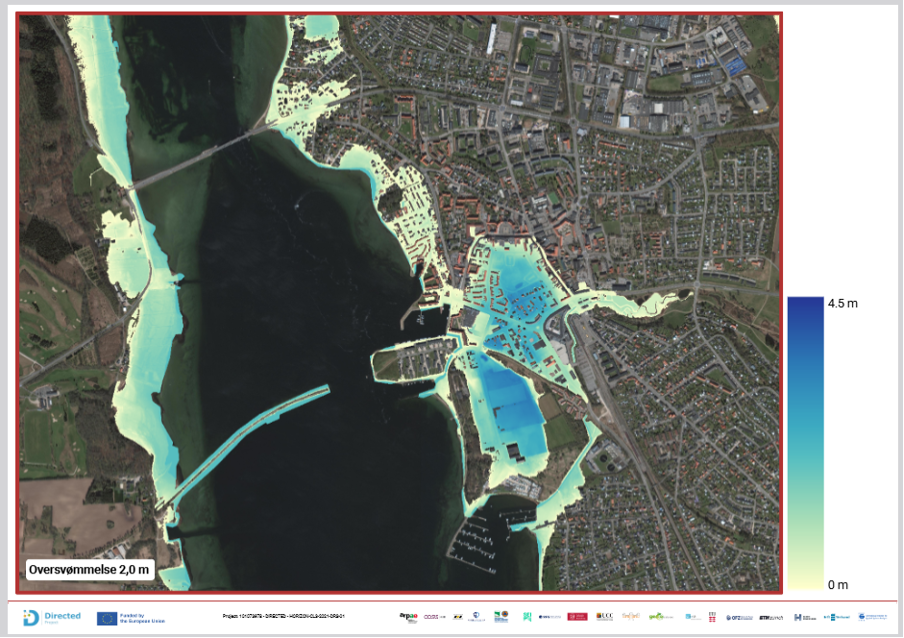
Figure 1: Flood map of Frederikssund for 1/100 year coastal storm surge event with 2 m surge
The Multi-Criteria Decision-Making (MCDM) process:
Coupling values with objectives
This workshop was highly interactive, with participants being introduced to the MCDM approach and engaging in a role-play exercise based around DRM and CCA in the city of Frederikssund in the Roskilde Fjord area.
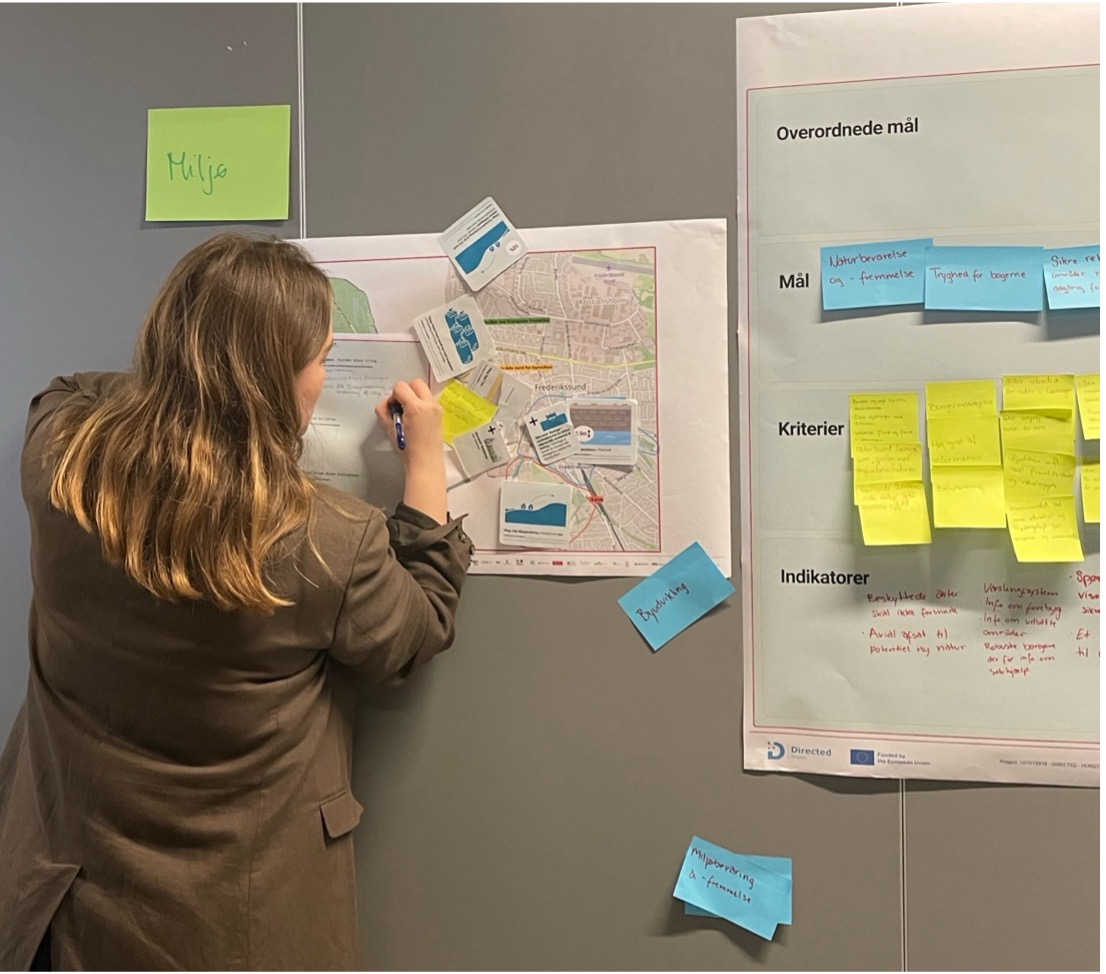
Participants were split into two groups and then assigned roles within the scenario, for example mayor, emergency chief, head of finance or politician with a specific interest area. The overarching goal that was given to both groups was to ‘Find the best possible solution to minimize coastal flood damages in the city’. Participants then had to explore the values for their assigned role within four categories: Environmental, Social, Economic and Other. These were then presented within the groups and used to build an objective hierarchy, coupling the values of the roles with their objectives for a solution to reduce the flood damages. The next step was to brainstorm how to measure these objectives through indicators.
Example on coupling values with criteria and indicators
For instance, if the value was a ‘more healthy and active community’, an objective coupled with the solution could be to introduce new areas for activities, and a concrete indicator for that could be the length of walk paths established in connection with the solution.
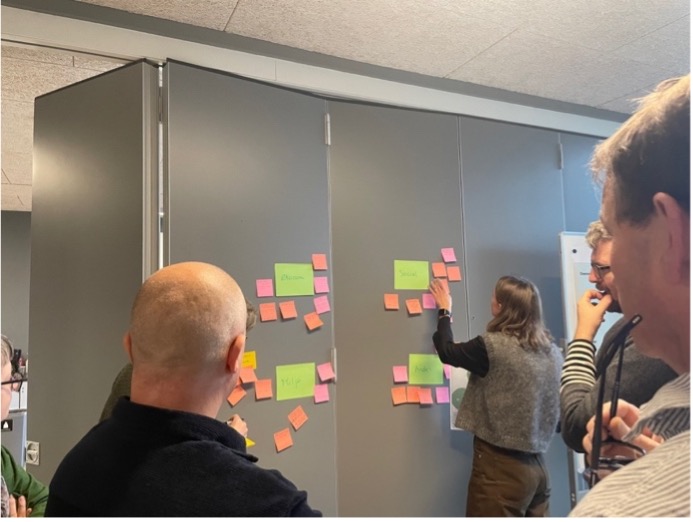
Figure 2: Groups allocate their values to the four categories
The exercise challenged the participants to couple values with objectives and indicators, so the political values are translated into something concrete related to the flood damage reduction measure which are measurable. This makes it possible to determine how the values are fulfilled and included in the risk management.
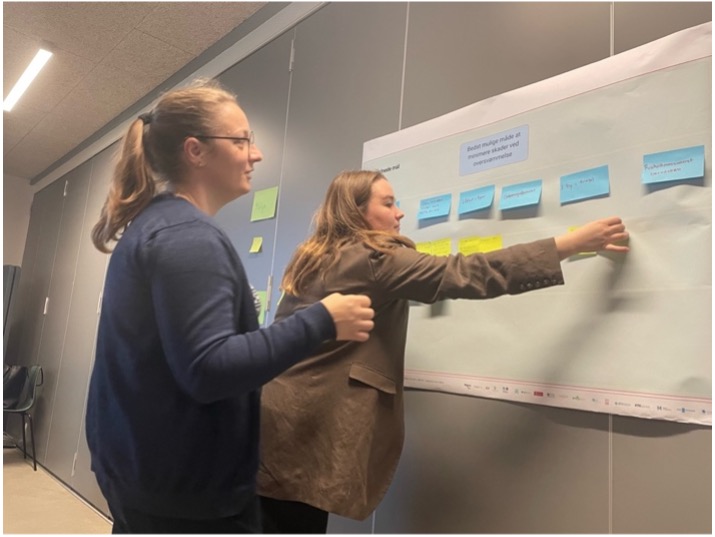
Figure 3: Objective goal hierarchy developed by one of the groups
Working with solutions
The next step required participants to choose measures/ solutions to reduce the coastal flood risk. The participants needed to assign one measure for each of the four sub-areas. The same measure could be applied to all sub-areas, or the group could decide to use different measures. Groups could then decide to choose add-ons, for example implementing walking/ cycling paths on a flood barrier.
In a real life situation several solutions would be chosen, but for the benefit of the exercise, the participants were presented with two predefined solutions. One solution was to protect the whole city with a flood wall or dike, and the other involved a managed retreat strategy in every area except the city centre. The participants were then able to be more creative with their third solution, as they were able to choose from a range of different options. Choosing the measures was a way to challenge the participants’ normal way of thinking and planning. The measures they could choose from included: Retreat, Do nothing, Flood walls, Emergency responses, etc.
However, the participants did not stick with one predefined measure for each sub-area. One of the groups decided on a partial retreat in one sub-area to make room for a dike and a salt meadow in front. This critical step highlighted the high level of creativity that can be involved when developing solutions.
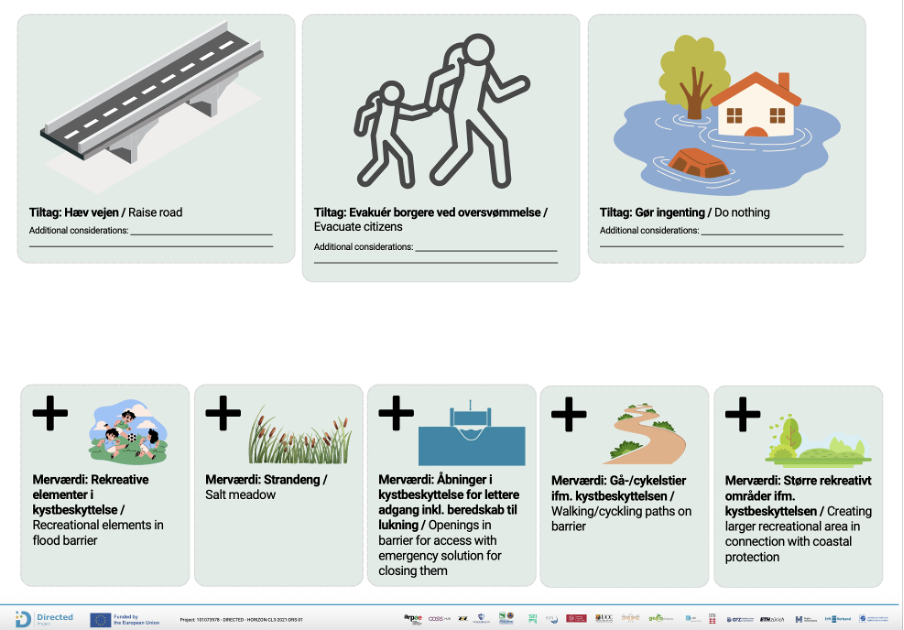
Figure 4: Additional options for measures
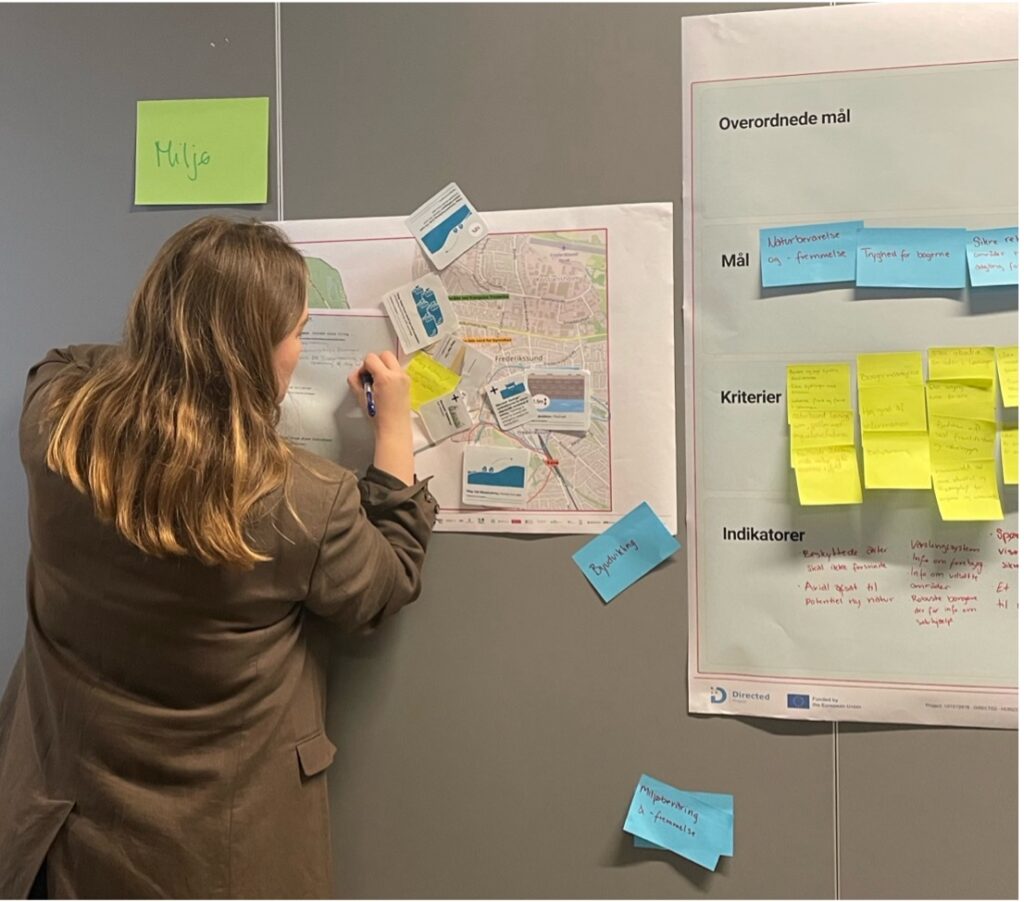
Figure 5: Map of one group’s solution for reducing flood damages in the city
Weighing by ranking
In MCDM, the measures are compared based on their performance between the different objectives and criteria, rather than only considering the economic effects or cost/benefit. In this process the different objectives can be equally important and thus weighted the same. However, it is also possible for some objectives to be more important than others. This weighing can be done in several different ways, but in order to force the participants to prioritise between the objectives (and not weigh everything equally), they were asked to rank the objectives by importance. This was first done individually by the participants with their role in mind. Afterwards the group had to negotiate one final ranking for their project.
This was a challenge in the groups as they normally try to find the common ground and best options in their work, so forcing them to prioritise challenged their way of thinking.
The Multi Criteria Assessment
The CLIMADA MCDM tool was then used by DIRECTED experts to develop preference scores and rank the three options/solutions, using the weighted value of the selected criteria. This allowed the overall preferred solution to be identified in each group.
Reflections
From the RWL host facilitators perspective, using role-play was really important as it assigned roles to participants’ which were different to their current role. This allowed us (as facilitators) to push the participants beyond the constraints of their day-to-day role and enabling them to be more open to a wider range of solutions and evaluation criteria. In practice, it would be ideal to have the ‘real’ stakeholders around the table, but this process would require additional time and resources. Additionally, the ranking exercise was found to be insightful, as it challenged them to think about which criteria were more important, rather than simply saying that they were all of equal importance.
Participants reflected on their key take away lessons from the workshop and highlighted new ideas for transferring the learning into their own practices. Overall participants learned the steps of the MCDM process through the Danish scenario, considered objectives from different perspectives, and engaged in reflective discussions around decision-making in their context. One representative from Frederikssund Municipality explained the value in the process helping them to see the decision-making “from many different perspectives than just my own”, while his colleague felt that the MCDM tool ‘… has some very nice potential because it’s very important to access a given solution in weighing different criteria against each other and that’s what we already do but having a method for it would be very helpful.” The representative from Roskilde Municipality highlighted how such a methodology helps to bring all perspectives together “so we can get the best solutions out of it together”.
The representative from the Danish Meteorological Institute expressed how “it really gave me a broad understanding of how important prioritising and planning actually is for the municipalities for climate adaptation”. While the representative from the Danish Emergency Management Agency shared how the workshop helped to show “how you have to prioritize a lot with the emergency planning and you have to prioritise the value of different criteria and that process is way harder than I would have expected” and inspired them to possibly consider social criteria in how they are “developing a digital risk map to visualise risk in different municipalities”.
Looking to the future
We are now in the final year of the Real World Lab as part of the DIRECTED project. These workshops have provided the RWL stakeholders with a valuable dedicated forum, which enables them to come together to explore new decision-support tools, and to share their knowledge and experience. Moving forward in 2026, two additional workshops are planned, one focusing on a tabletop simulation exercise and another on continuing collaboration and capturing synergies post-DIRECTED.
For more information about the Danish Real World Lab contact:
Kaija Jumppanen Andersen: kjuan@dtu.dk
Or